Why Copilot Is Falling Behind for Shopify Merchants
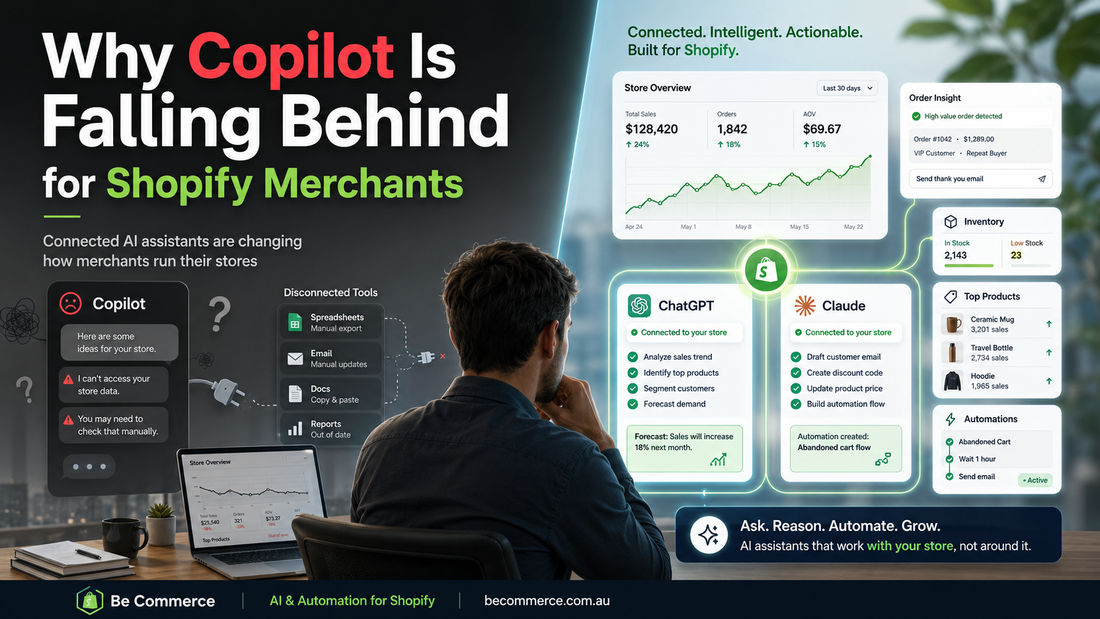
For Shopify merchants, AI is no longer just a writing assistant. It is becoming a store operator, analyst, merchandising assistant, customer service co-pilot and automation layer.
That shift matters because many merchants already live inside the Microsoft ecosystem. Outlook, Teams, Excel, SharePoint and Microsoft 365 are deeply embedded in daily operations. So, on paper, Microsoft Copilot should be the obvious AI assistant for eCommerce teams.
But in practice, many merchants are finding a gap between what Copilot promises and what a growing Shopify business actually needs.
"A recent Reddit discussion captured the frustration clearly: a merchant who adopted Copilot because they already used Microsoft email and Office said they could not rely on or trust its outputs — describing it as stronger for basic Office productivity than for deeper reasoning, technical support or precise task execution."
For a Shopify merchant, that distinction is critical.
Shopify merchants need more than document help
A merchant does not just need an AI assistant that can summarise emails or rewrite a paragraph. They need an assistant that can help answer questions like:
- Which products are slowing down this week?
- Which collections should be promoted based on margin, stock and conversion rate?
- Which customers should be targeted before a sale?
- Which orders need attention?
- Which products are at risk of going out of stock?
- Which abandoned-cart flows are underperforming?
- What should be changed in Shopify Flow, Klaviyo, Google Ads or Meta campaigns?
- Can this assistant actually take action, or does it just explain what I should do manually?
That is where the gap starts to appear. Copilot is positioned heavily around productivity inside the Microsoft environment. That has value. But for Shopify merchants, the operating system of the business is not Word, Outlook or Teams. It is Shopify, plus the surrounding stack of apps, integrations, reporting tools, fulfilment systems, customer service platforms and marketing channels.
An AI assistant that cannot reliably understand or act on that commerce context quickly becomes another tab, not a productivity gain.
The problem with Copilot for Shopify merchants
The issue is not simply that Copilot is "bad". The issue is that it often feels disconnected from the actual workflows merchants care about.
A Shopify merchant needs an AI assistant to reason across live commercial data — product data, customer data, order history, inventory levels, discounts, collections, fulfilment information, campaign performance and customer service context. If the AI cannot access that information, it can only provide generic advice.
That creates a familiar problem:
- The merchant asks a business question.
- The AI gives a broad answer.
- The merchant still has to export data.
- The merchant still has to check Shopify manually.
- The merchant still has to validate the numbers.
- The merchant still has to take the action themselves.
That is not automation. That is assisted guessing. For merchants running lean teams, this matters. Time spent moving between Shopify Admin, Excel, emails, reports and apps is time that could be spent improving products, campaigns, fulfilment and customer experience.
ChatGPT and Claude are moving closer to the store
This is where ChatGPT and Claude are becoming more compelling for Shopify merchants. Shopify's AI Toolkit is designed to connect AI tools to Shopify's developer platform and store management capabilities through plugins, skills or MCP servers — helping AI tools work with Shopify correctly, rather than guessing how Shopify is implemented. Shopify's Storefront MCP documentation also describes how AI assistants can connect to real-time commerce data from Shopify stores using Model Context Protocol servers, enabling customers to search, ask and buy through natural language experiences.
In practical terms, this means assistants such as ChatGPT and Claude can increasingly be connected to Shopify data and workflows in ways that are far more useful than a generic productivity assistant. That opens the door to AI assistants that can:
- Analyse Shopify sales performance
- Query orders, customers, products and inventory
- Generate product, collection and merchandising recommendations
- Support reporting and forecasting
- Help create or adjust operational workflows
- Assist with product updates, discount logic and campaign planning
- Combine Shopify data with other business systems
OpenAI has also created a merchant pathway for product discovery in ChatGPT, with Shopify and Etsy catalogues already integrated for product participation in ChatGPT shopping experiences. The direction is clear: AI assistants are moving from "answer engines" to connected commerce interfaces.
The key difference: advice versus action
For Shopify merchants, the real AI advantage is not whether a tool can write a better email. The advantage is whether it can understand the store and help operate it. There is a major difference between these two responses:
Generic AI response
"Your store may benefit from promoting best-selling products and improving abandoned cart emails."
Connected Shopify AI response
"Your best-performing product this week is Product A, but Product B has higher margin and enough inventory to support a campaign. Your abandoned cart conversion rate has dropped by 18% over the last 14 days. I recommend promoting Product B, updating the cart email subject line, excluding low-stock variants and creating a VIP customer segment for early access."
The first answer is content. The second answer is commerce intelligence. This is why connected AI matters.
Why the Microsoft ecosystem is not enough
Many Shopify merchants are Microsoft users. They run inboxes in Outlook, planning in Excel, meetings in Teams and documents in SharePoint. That creates a strong reason to try Copilot first. But productivity data is not the same as commerce data.
A merchant's most important business context often lives outside Microsoft:
- Shopify
- Klaviyo
- Meta Ads
- Google Ads
- Gorgias or Zendesk
- Peoplevox or warehouse systems
- Australia Post, Starshipit or fulfilment platforms
- Reviews platforms
- Loyalty apps
- Returns platforms
- Finance and BI tools
If Copilot is mostly helping with the Microsoft layer, it is only seeing part of the business. A Shopify merchant needs AI that can connect across the store, the customer journey and the operational stack. Otherwise, the assistant becomes useful for meeting notes, but limited for actual growth.
Copilot may still have a role
Copilot is not irrelevant. For merchants already using Microsoft 365, it can still help with:
- Summarising long email threads
- Drafting internal updates
- Turning meeting notes into action lists
- Reviewing documents
- Creating first-draft spreadsheet summaries
- Helping staff work faster inside Microsoft tools
But that is not the same as being a true Shopify assistant. For commerce teams, the more valuable assistant is the one that can answer operational questions, interpret live store data and safely trigger action. That is where ChatGPT, Claude and MCP-based Shopify integrations are moving faster.
The new benchmark for Shopify AI assistants
The benchmark for merchant AI is changing. It is no longer enough for an assistant to sound intelligent. It needs to be connected, permissioned, auditable and action-oriented. A useful Shopify AI assistant should be able to:
- Access the right data securely
- Respect store permissions and approval rules
- Explain recommendations clearly
- Show the source of its analysis
- Automate repetitive workflows
- Work across Shopify and key apps
- Reduce manual reporting
- Help teams move from insight to action
"AI should not sit beside the store. It should work with the store."
Where beCommerce fits in
beCommerce helps Shopify merchants move beyond generic AI advice and into practical AI automation. As a Shopify-focused agency, beCommerce works across store build, integrations, automation, reporting and operational workflows. That makes AI implementation more valuable because it is not treated as a standalone chatbot — it is connected to how the merchant actually runs their business.
For Shopify merchants, the goal is not to add another tool. The goal is to build smarter systems, which may include:
- Shopify AI assistant integrations
- Automated reporting workflows
- Customer service automation
- Product and inventory intelligence
- Campaign and merchandising support
- Shopify Flow automation
- App and API integrations
- Custom assistant workflows for internal teams
beCommerce is a leader in automation, AI use and Shopify assistant integration for merchants that want practical, commercially useful AI.
Final thought
Copilot may remain useful for Microsoft productivity. But Shopify merchants need more than productivity. They need AI that can understand their store, analyse live data, recommend meaningful actions and help execute operational workflows. That is why Copilot is falling behind for Shopify merchants.
The next generation of eCommerce AI will not be defined by who writes the best paragraph. It will be defined by who connects most effectively to the merchant's business and helps them make better decisions, faster. Get in touch to find out how beCommerce can help you build a smarter, connected Shopify operation.
Is your store making any of these mistakes?
We audit Shopify stores for exactly these kinds of conversion-killing patterns — the ones that have become normalised until you see them through a customer's eyes.
Book your free audit →